
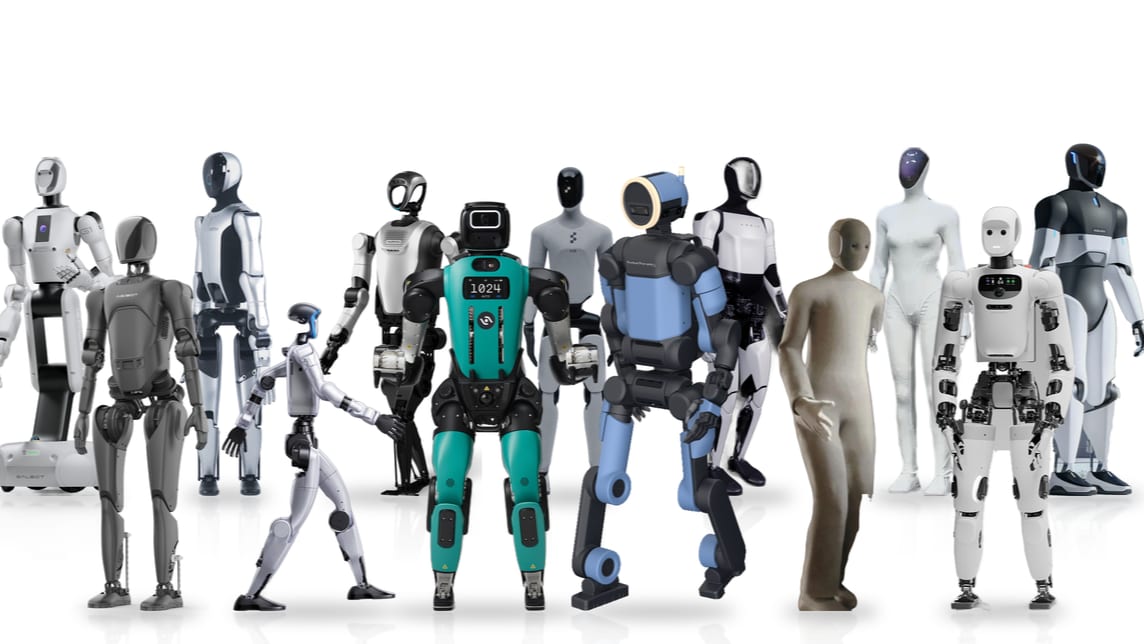
Think about how many jobs involve walking over to something, picking it up, and putting it somewhere else. Stocking shelves. Loading parts into a machine. Moving boxes around a warehouse. Folding laundry at home. Almost every place we work was built around the human body. That's the idea behind humanoid robots: a robot shaped like us could walk into those same spaces and use the same shelves, carts and tools as we do.
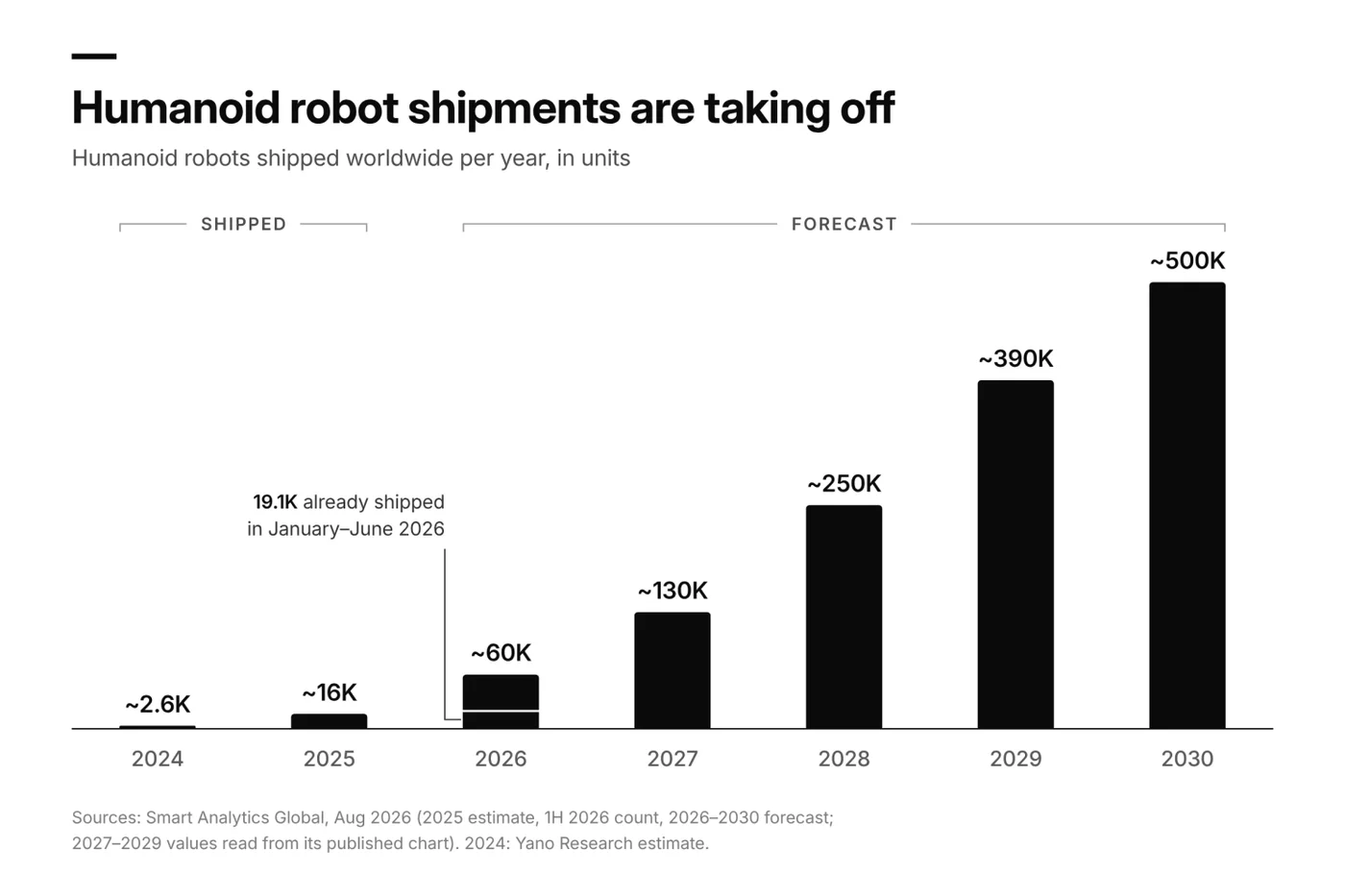
Up until recently, humanoid robots seemed to only exist in demos. Now, in the first half of 2026, thousands of humanoid robots have shipped worldwide for use in real work and the trend for humanoid robots growth is explosive. Let's dive in deeper.
Who's buying these humanoid robots?
According to SAG (Smart Analytics Global, a San Francisco-based research firm), in 2026 more than 70% of this year's robots went to factories, warehouses, shops and other businesses. This includes companies like Chinese electric carmaker BYD, Taiwan-based electronics manufacturer and iPhone assembler Foxconn, German automaker BMW, and Chinese smartphone and tablet manufacturer Longcheer. They are using or testing humanoid robots to move materials, load parts and check product quality. Some robots are already working on production lines; others are still being tested. Labs, schools and entertainment make up the rest of the 30%. More than 97% of these robots were produced by Chinese companies.
Who's shipping the most humanoid robots?
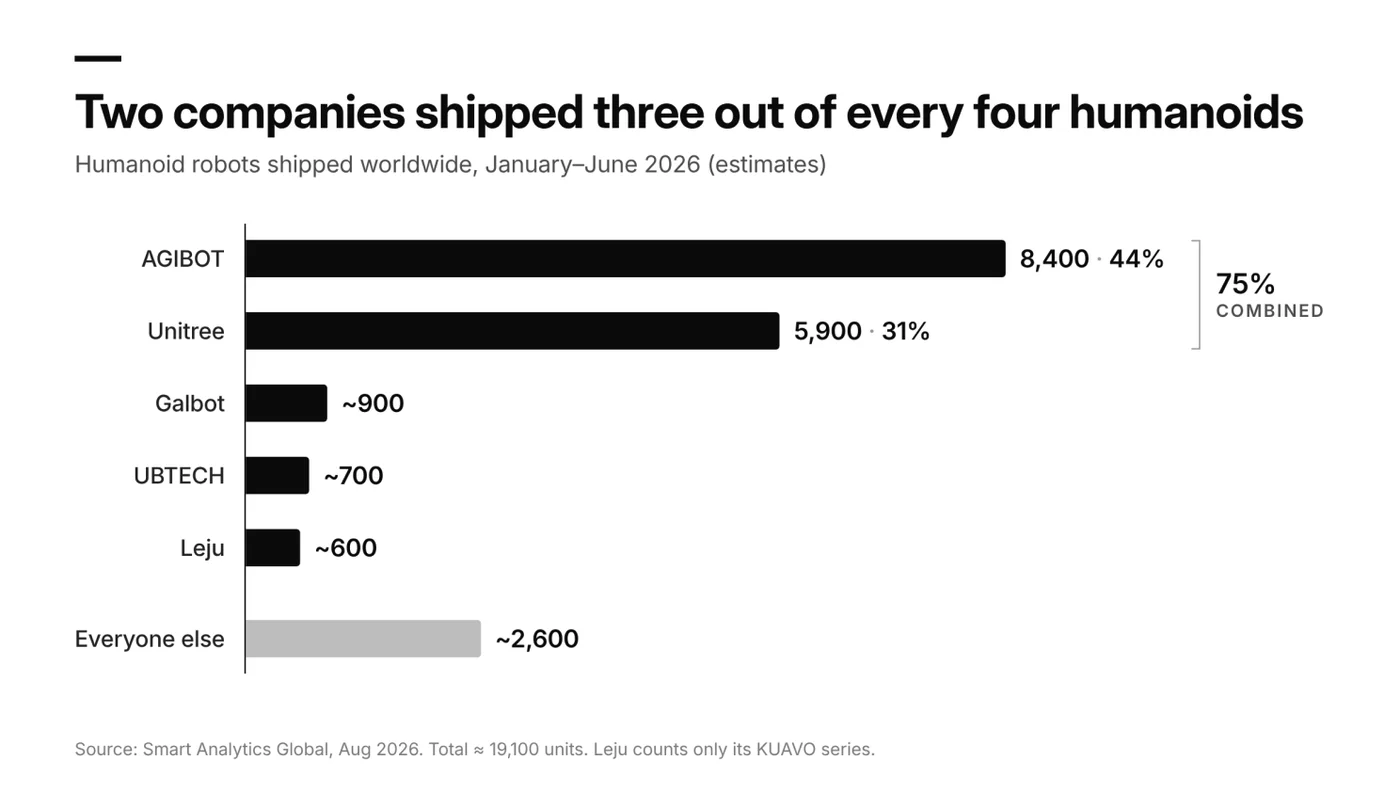
Two companies, AGIBOT and Unitree, shipped about three out of every four humanoids in the first half of 2026 according to SAG. A year ago, Unitree was No.1. This year AGIBOT grew more than sixfold and took the top spot.
AGIBOT: No.1 by humanoid shipments in 1st half of 2026
AGIBOT is a Shanghai company founded in 2023 by former Huawei engineers. It shipped more than 8,000 humanoids in the first half of 2026, up from roughly 1,300 a year earlier.
AGIBOT makes both walking and wheeled robots. It's also known for its advanced robotic hands. A version of its flagship A2 set a Guinness World Record in late 2025 by walking about 106 km (66 miles). Check out the video below!
AGIBOT offers a range of humanoid robots for sale, including the compact X2 Neo (listed at $25,600) and X2 Ultra, alongside the full-size A2 Lite (listed at $44,560), A2 Ultra, A3, and A3 Ultra. These models are designed for applications such as live performances, reception, guided tours, and robotics research.
Unitree made humanoids affordable
You've probably seen Unitree's robots doing backflips or boxing online. Wang Xingxing started the company in 2016 in Hangzhou, the same city where Alibaba is based. Unitree began with robot dogs and later moved into humanoids.
In the first half of 2026, Unitree shipped about 5,900 humanoid robots, up 170% from the previous year. Its flagship model is called G1, a compact humanoid about 4 ft tall. It came out in 2024 and can do movements from athletic moves to slow, smooth tai chi. In June 2026, Unitree said cumulative G1 production had passed 11,000 units. For a fun demo, check out the video below of G1 doing Kungfu.
Price is a big part of Unitree's appeal. The G1 starts at $13,500, and the simpler R1 Air starts at $4,900, much cheaper compared to other humanoid robots. At those prices, universities, research labs, and startups can actually afford humanoid robots, and those groups are still a big part of Unitree's customer base.
Investors are excited too. Unitree went public on Shanghai's STAR Market on August 19, 2026, and its shares closed about 460% above the IPO price on the first day of trading.
Galbot: humanoids on wheels
Beijing-based Galbot has shipped almost 1,000 humanoids in 2026 so far. Its main robot is also called G1 (yes, another G1), but it’s a very different machine. It stands up to about 5'8" and has a head and two arms on a wheeled base. Its body can rise and lower, so it can reach anything from the floor to shelves about 7 feet up. It runs about 8 hours on a charge, which suits the flat floors of stores and warehouses.
Galbot says its G1s work around the clock in about 100 warehouses that pack online orders, and in more than 170 robot-run kiosks across 40-plus Chinese cities. In March 2026, Beijing regulators gave Galbot China’s first license to sell medicine using humanoid robots.
In August 2026, Galbot previewed the ET1, its first two-legged humanoid, ahead of its World Robot Conference debut in Beijing.
UBTECH: built for the factory floor
Shenzhen-based UBTECH came fourth with about 700 shipment units in the first half of 2026. Its flagship robot, the Walker S2, is built for factories and has a neat trick. When its battery runs low, it walks to a swap station and changes the battery itself in about three minutes. It carries two batteries, so it stays on during the swap and can keep working around the clock. It can also squat down and lift boxes of up to 15 kg (33 lb), from floor level to about 6 feet high.
Chinese carmakers like BYD and Geely have bought Walker S2 for their factories. Airbus has also bought Walker S2s to test in aircraft production, though Airbus says it’s still early concept testing.
Leju: powered by Huawei AI
Leju Robotics, another Shenzhen company, came fifth with about 600 units in the first half of 2026. Its full-size humanoids are called KUAVO, after Kuafu, a giant in Chinese mythology who chased the sun. They run an operating system built on OpenHarmony, the open-source base of Huawei’s HarmonyOS, and have been paired with Huawei’s Pangu AI model.
Leju is growing fast. It sold 577 KUAVO robots in 2025, up from just 32 the year before, according to its IPO filing. Their main job so far is data collection. At training centers, robots repeat tasks over and over to create training data for AI. Universities and research labs buy them too. Factory work is only getting started.
The US players: Agility and Figure
American companies ship far fewer humanoids today. But two of them have some of the best proof that these robots can do real, repeated work.
Agility Robotics
Agility, based in Oregon, makes a robot called Digit for warehouse work. Its Digit 4 robots have already worked more than 65,000 hours for companies like GXO, Schaeffler, Amazon and Toyota. At one GXO warehouse near Atlanta, Digit has moved over 100,000 totes (plastic shipping bins), and it gets the job right about 98% of the time.
The new Digit 5 came out on September 15. It can lift up to 50 pounds, and a 9-minute charge gives it 90 minutes of work. It also keeps an eye out for people. If someone gets too close, it walks around them, stops, or sits down. Agility says it already has more than $300 million in orders, and early customers can start using it in the first half of 2027.
Figure AI
Figure, based in California, sent its older robot, Figure 02, to work at BMW’s car plant in Spartanburg, South Carolina. For 11 months, it worked 10-hour shifts on weekdays and lifted more than 90,000 metal car parts into place for welding. Its newest robot, Figure 03, is made for the home. It’s 5 feet 8 inches tall, can carry up to 44 pounds (20 kg), and runs for about 5 hours on a charge.
Figure trained its new Helix 2.5 AI on a huge collection of videos of people doing everyday things. Then it sent the robot into 30 San Francisco Bay Area homes without collecting any data there first. The robot tidied toys, folded towels and made beds, and it finished the whole job 56% of the time.
Coming soon: famous robots not shipped yet
Some of the best-known humanoids haven't actually been sold yet. You've seen them in videos and on stage, and a few are just starting production, but none are shipping in real numbers. Here are the big ones to keep an eye on.
Tesla Optimus (US). The most famous humanoid of all, and still not for sale yet. Tesla turned its old Model S and X line in Fremont into an Optimus line. Elon Musk said in July that the early ramp will be "quite flat and long." The next version, Optimus V3, hasn’t been shown yet. Tesla has floated a price of $20,000 to $30,000 for Optimus.
1X NEO (US). A soft, quiet robot for your home. You can pre-order it for $20,000 or $499 a month, and 1X says deliveries start this year. At first, a 1X expert can remotely guide it through chores it doesn’t know yet.
Boston Dynamics Atlas (US). Boston Dynamics started building the production Atlas in January 2026, but all 2026 units are going to Hyundai (its owner) and Google DeepMind, with other customers starting in early 2027. Hyundai plans to put 25,000 of them in its factories over time.
XPeng IRON (China). This robot from the Chinese electric carmaker XPeng moves so much like a person that some people thought a human was inside. XPeng opened an IRON production line in September and plans to start selling it in 2027.
Apptronik Apollo (US). Austin-based Apptronik has tested Apollo robots with Mercedes-Benz and GXO. Its current Apollo 2 mostly collects training data at the company's new "Robot Park" in Austin. The version it plans to sell, Apollo 3, hasn't been released yet.
NEURA 4NE1 (Germany). NEURA Robotics is taking refundable €100 reservations for its 4NE1 humanoid, priced at about €98,000 for businesses. The company says the first industrial units ship in late 2026.
If even a couple of these hit their targets, next year's shipments could look very different. Humanoids are starting to look like a real industry.
Looking Ahead
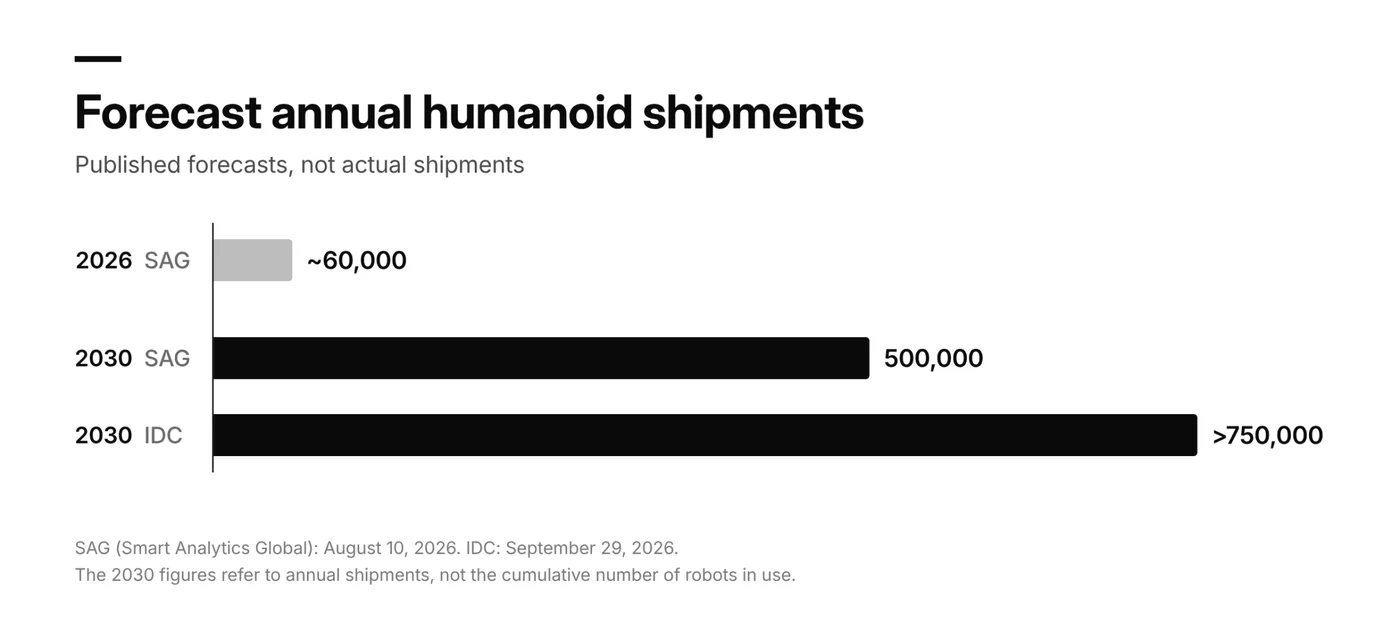
Humanoid robot shipments are still small today, but they are growing fast. About 2,600 humanoids shipped worldwide in 2024 and about 16,000 in 2025. Smart Analytics Global forecasts shipments will reach half a million by 2030, and another market research firm, IDC, forecasts more than 750,000. That’s roughly 30 to 50 times more robots in just five years.
So what will things look like 20 years from now? We may see humanoids everywhere: tidying up at home, stocking shelves at the store, and delivering packages on the street. The robots you watch in videos today could one day feel as normal as the phone in your pocket.
Enjoyed this article?
Subscribe to FutureTech
Biweekly AI & tech insights for 1,700+ readers.
Delivered by Substack. Unsubscribe anytime.