
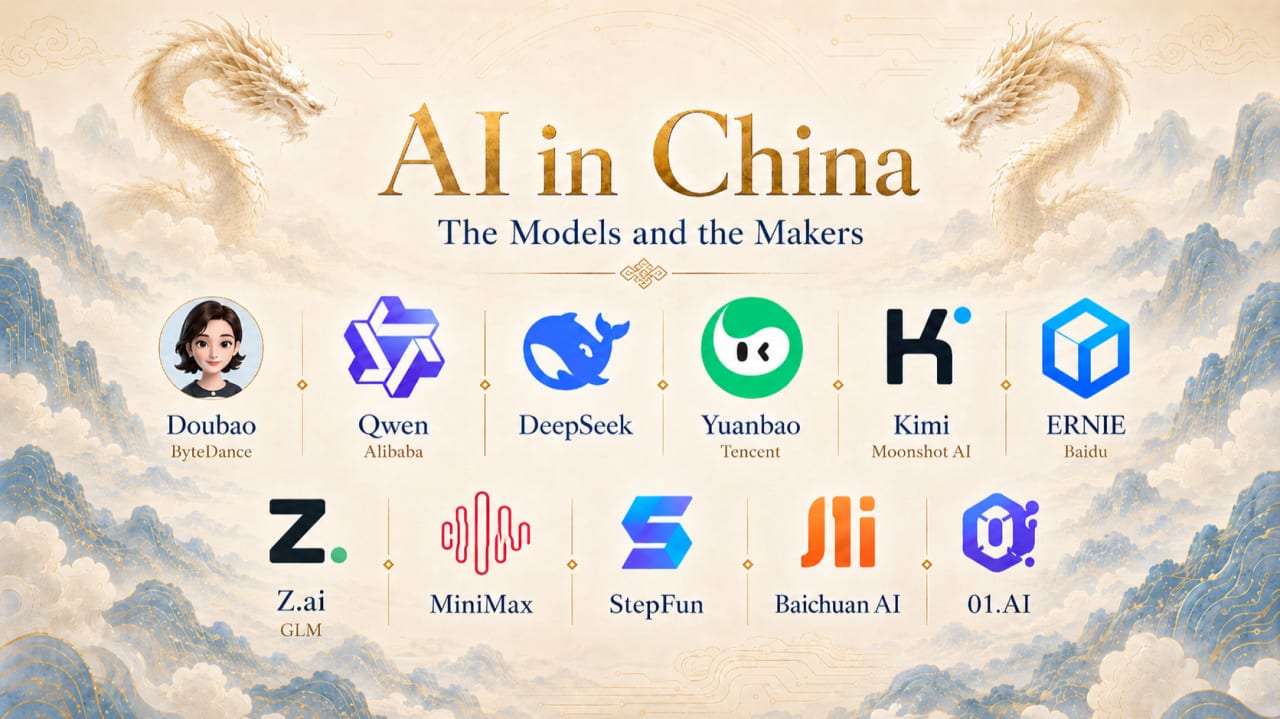
AI is taking off globally. Most of you are already familiar with AI developments in the US, especially tools like ChatGPT, Claude and Gemini. China is also moving quickly in AI, but its major models and companies are less familiar to many people outside China. This article gives an overview of the major Chinese AI models and the model makers behind them.
Top 6 Most-Used Consumer AI Apps
According to data research company QuestMobile, the six most-used consumer AI apps in China are Doubao, Qwen, DeepSeek, Yuanbao, Kimi and Ernie. They come from ByteDance, Alibaba, DeepSeek, Tencent, Moonshot AI and Baidu respectively. Below is a brief introduction to each one.

1. Doubao, from TikTok maker ByteDance
Doubao is an AI app created by ByteDance, the company behind TikTok and Douyin, the Chinese version of TikTok. The name Doubao literally means "bean bun," a soft Chinese steamed bun often filled with sweet bean paste. The name feels casual, cute and familiar rather than technical, which fits ByteDance's broader branding strategy: making AI feel approachable and mass-market. As of May 2026, Doubao had 369 million users, which is more than the population of the US.
One reason Doubao grew so quickly in China is that ByteDance already had a massive user base through Douyin. Doubao has been free to use, although ByteDance started testing paid plans in May 2026 for users who want more advanced features.
Doubao's latest model family, Seed 2.1, is designed to be better at coding and handling complex tasks. ByteDance's AI push goes beyond Doubao: it has built many other notable AI tools, including the AI-powered video and photo editing app CapCut and the AI video generation tool Seedance.

2. Qwen, from Alibaba
Qwen is the second most-used consumer AI app in China, developed by Alibaba. Qwen comes from its Chinese name Qianwen, which means "a thousand questions" and alludes to "asking many questions to find answers." The name suggests broad knowledge, reasoning and the ability to answer many different kinds of questions. As of May 2026, Qwen had 162 million users. Like ByteDance's Doubao, Qwen benefited from Alibaba's huge existing consumer base. The Qwen consumer app is free to use.
Qwen is also one of the most popular open-weight AI models in the world. Alibaba has released many Qwen models for developers to use and build on. Its latest flagship model, Qwen3.7-Max, offers strong coding, reasoning and agent capabilities at a much lower price than many leading US frontier models.

3. DeepSeek
DeepSeek is one of China's most talked-about AI companies. Its name suggests "searching deeply" for better answers. Unlike Doubao and Qwen, DeepSeek is not backed by a huge consumer internet company. It came from High-Flyer, a Chinese quant hedge fund. DeepSeek became famous when it released its first open-weight model, R1, at very low cost. It showed that a Chinese startup could build strong reasoning AI without spending as much as leading US labs.
DeepSeek is free for its consumer app. As of May 2026, DeepSeek had 127 million users. DeepSeek is also popular with developers and is one of the most widely used Chinese open-weight models.
DeepSeek's latest model family is the DeepSeek-V4 series, with V4-Pro as its stronger model and V4-Flash as its faster, cheaper model. It focuses on better reasoning, coding, long-context work and agent capabilities while keeping pricing low.
In June 2026, DeepSeek raised more than $7.4 billion in its first funding round. The round valued the company at $50 to $60 billion, with Tencent one of the major investors. DeepSeek's valuation is still much lower than OpenAI and Anthropic, which are close to $1 trillion each.

4. Yuanbao, from Tencent
Yuanbao is an AI app developed by Tencent, the company behind WeChat, Tencent Games, Tencent Docs and Tencent Cloud. As of May 2026, Yuanbao had 54 million users, the fourth most popular consumer AI app in China.
The name "Yuanbao" refers to traditional Chinese money, so it suggests value, wealth and good luck. Yuanbao is powered by Tencent's Hunyuan models and can help with chatting, writing, document reading, image understanding and other everyday tasks.
Yuanbao grew quickly because Tencent has one of the strongest digital ecosystems in China. Its biggest advantage is distribution: Tencent can bring AI directly into apps people already use every day, especially WeChat, which is central to communication, payments, content and other daily services in China.

5. Kimi, from Moonshot AI
Moonshot AI is the Beijing startup behind Kimi. The name "Moonshot" suggests an ambitious attempt to solve a very hard problem. Its Chinese name means "the dark side of the moon," which may be inspired by Pink Floyd's album. Kimi is its consumer AI app, known first for reading and summarizing very long documents.
Unlike Doubao, Qwen and Yuanbao, Kimi does not come from a giant consumer internet company, but it became popular among students, researchers, writers and developers. As of May 2026, Kimi had close to 7.5 million users in China. Its latest models include Kimi K2.6 for general use on the Kimi website and Kimi K2.7 Code for use in agentic coding harnesses like Kimi Code.

6. Ernie, from Baidu
Baidu is China's main search engine and one of the country's earliest big AI players. Its AI model is called ERNIE, which stands for "Enhanced Representation through Knowledge Integration." Baidu was among the first major Chinese companies to launch a ChatGPT-style bot in 2023. After years of keeping most of its strongest models private, Baidu changed direction in 2025 by making ERNIE Bot free and releasing ERNIE 4.5 as open source.
Its latest major model, ERNIE 5.1, focuses on stronger reasoning, agent tasks and creative writing while lowering training and inference costs. Baidu's biggest advantage is that it can connect AI directly to Baidu search, maps, cloud services and other products people and businesses already use in China.
The Six Little Dragons of AI in China
Beyond the AI models from China's tech giants — ByteDance, Alibaba, Tencent and Baidu — and the breakout startup DeepSeek, Chinese tech media often group the leading independent AI labs under one nickname: the "six little dragons" or "six little tigers." They include Moonshot AI, described above, as well as Z.ai, MiniMax, StepFun, Baichuan AI and 01.AI.
1. Zhipu AI / Z.ai: GLM models
Zhipu AI, now branded globally as Z.ai, grew out of Tsinghua University and is one of China's most important AI startups. The name "Zhipu" loosely suggests an "intelligence atlas" or "map of knowledge," which fits its focus on building general AI systems.
Z.ai's model family is called GLM, short for General Language Model. Z.ai has surged over 2,000% since its January 2026 IPO in Hong Kong, briefly crossing a HK$1 trillion market cap. The rally was triggered by the release of its latest GLM-5.2 model, which performs on par with top US AI models and caused a major spike in Wall Street interest.

2. MiniMax: Hailuo, Talkie, MiniMax M3
MiniMax is a Shanghai AI company known for multimodal models and consumer AI products. Its name comes from the "minimax" idea in math and game theory: reduce the downside while maximizing the upside. MiniMax went public in Hong Kong right alongside Z.ai in January 2026.
MiniMax is best known for Hailuo, its AI video-generation product, and Talkie, its AI companion app. Its latest major language model is MiniMax M3, built for agents, coding, multimodal chat and long-context tasks. Its current video generation model, Hailuo 2.3, focuses on better body movement, facial expressions and physical realism.

3. StepFun
StepFun is a Shanghai AI startup focused on fast, practical models for agents and multimodal tasks. Its Chinese name, Jieyue Xingchen, roughly suggests "stepping toward the stars." StepFun's latest major model is Step 3.7 Flash, a high-efficiency model built for production-grade agents.
StepFun is especially relevant for enterprise software, smartphones, smart cars and other real-world AI products. StepFun officially moved to file for a Hong Kong IPO in June 2026, aiming for a market valuation of up to $12 billion.

4. Baichuan AI
Baichuan AI was founded by Wang Xiaochuan, the former CEO of Sogou, a search company later acquired by Tencent. The name "Baichuan" means "a hundred rivers," suggesting that the company brings many streams of knowledge together. Baichuan started as a general AI model company but is now best known for medical AI. Its latest major model is Baichuan-M4, a clinical-grade medical agent system. It can support follow-up visits, patient memory, evidence retrieval, document reading and medical image understanding.
5. 01.AI
01.AI was founded by Kai-Fu Lee, the former head of Google China and a well-known AI investor. Its Chinese name, Lingyi Wanwu, translates to "zero-one and everything." The name suggests that digital intelligence can grow from simple building blocks into many real-world applications. 01.AI first became known for its Yi open models, including Yi and Yi-Coder. More recently, the company has focused more on practical AI agents and business tools instead of trying to train the largest frontier models.
Concluding Thoughts
1. Free for consumers
Most major Chinese consumer AI apps are free, with only a few, such as Doubao, testing paid plans. This is a deliberate strategy. Many of these companies already make money from ads, gaming, cloud, e-commerce or enterprise software, so AI can be used to grow engagement and keep users inside their ecosystems. Consumers get strong models at no cost, while companies bet that scale today will lead to revenue later.
2. A competitive field
Dozens of companies are now competing in China's AI race. This pushes model quality up and prices down, which benefits users and developers. Over time, though, the market will likely narrow. Training frontier models is expensive, and funding tends to flow toward the strongest players. Some labs may merge, get acquired or specialize. Baichuan's shift toward medical AI and 01.AI's shift to an enterprise LLM platform are early examples.
3. Open weights as the edge
Many Chinese AI companies, including DeepSeek, Alibaba, Z.ai and Baidu, release open-weight models and offer very cheap developer APIs. This matters because AI costs are becoming a real issue for businesses. Open-weight models let companies run AI on their own infrastructure, reduce vendor lock-in and customize models for their needs. If companies keep looking for cheaper AI options, Chinese open-weight models are likely to gain more users among developers and businesses around the world. This could accelerate AI diffusion by making AI easier and cheaper to adopt.
Enjoyed this article?
Subscribe to FutureTech
Biweekly AI & tech insights for 1,700+ readers.
Delivered by Substack. Unsubscribe anytime.