
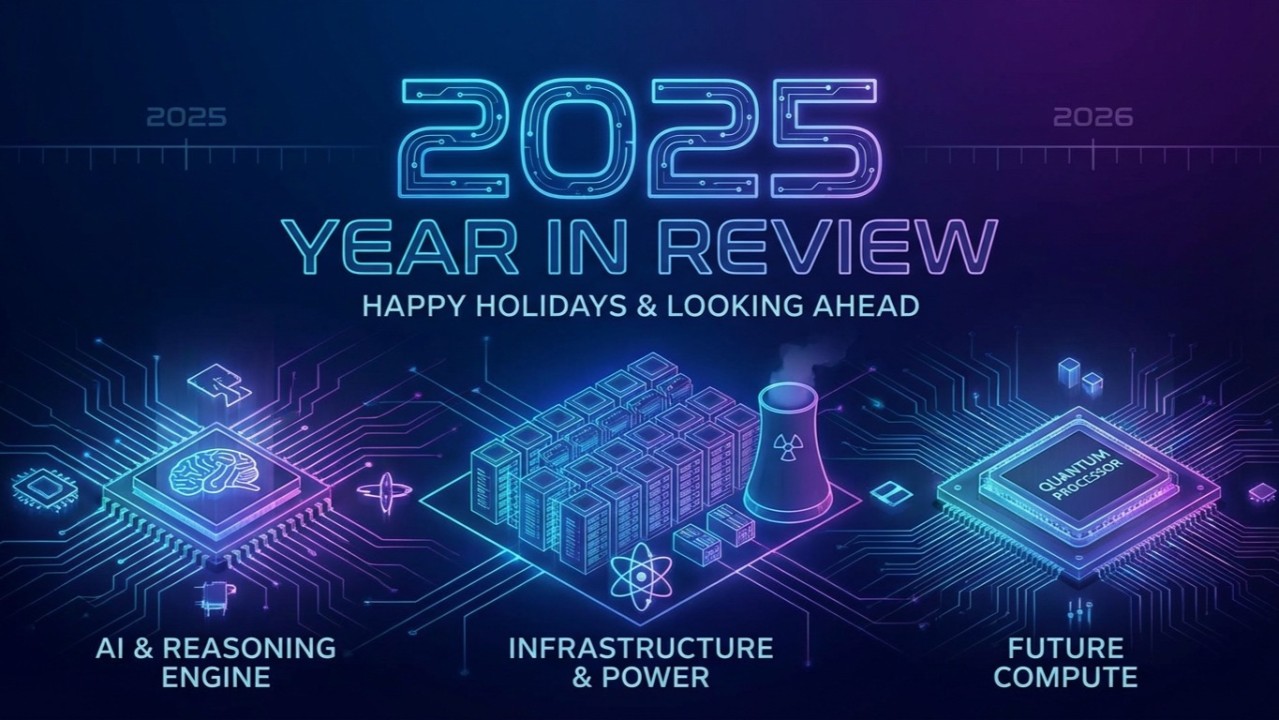
Hi friends! Happy New Year! As 2026 begins, I'm looking back on an incredible 2025 of writing: AI leveled up fast, data centers became central, and powering intelligence became a headline topic. Thanks for reading along. Here are my top five pieces.
(1) The Great Data Center Spending Boom
The Great Data Center Spending Boom
Data centers are the physical backbone of the digital world. They house the servers, networking gear and power systems that run cloud services, AI workloads...
linkedin.com
If you want to understand where AI is heading, follow the money. And in 2025, the money is flooding into data centers.
This piece tracks the unprecedented capital expenditure happening across Big Tech, the billions flowing into buildings, chips, and cooling systems. It connects the dots between Nvidia's earnings calls, hyperscaler expansion plans, and the physical infrastructure that will power the next generation of AI.
The thesis: we're in the early innings of an infrastructure supercycle. AI isn't just software; it's steel, concrete, copper, and electricity. Understanding this helps you see where the opportunities (and constraints) really are.
(2) How Nuclear Is Powering America's AI Boom
Silicon Meets Uranium: How Nuclear Is Powering America's AI Boom
AI now sits at the heart of the data center business. Data centers consume huge amounts of electricity and need it every minute of the day...
linkedin.com
Microsoft, Google, and Amazon are all betting on nuclear reactors.
AI data centers are power-hungry beasts. By 2028, they may double their electricity consumption. And as carbon commitments collide with compute demands, the math leads inexorably to nuclear.
This essay covers the deals being struck, Three Mile Island's restart, small modular reactors, next-gen designs, and what they mean for the future of both AI and energy.
I loved researching this because it's the kind of story that connects dots most people don't see. The future isn't just about better models; it's also about the physical infrastructure that makes them possible. And right now, that means atoms.
(3) What Does Nvidia Actually Do? A Deep Dive into the Engine of AI
What Does Nvidia Actually Do? A Deep Dive into the Engine of AI
You've probably heard of Nvidia, yet most people still can't explain what it actually does. Three engineers launched Nvidia in 1993...
linkedin.com
Everyone knows Nvidia is important. Fewer people can explain why.
This deep dive goes from the architecture of a GPU to the CUDA ecosystem to the data center products that make modern AI possible. It's the kind of foundational piece I wish I'd had when I first started paying attention to the AI boom.
The goal was simple: after reading this, you should be able to explain to anyone why a company that started making video game graphics chips became the most important company in AI.
Nvidia remains the linchpin of the entire AI infrastructure stack. Understanding what they actually do and why it's so hard to compete with them is essential context for everything else happening in AI.
(4) Should You Still Learn to Code in the Age of AI?
Should You Still Learn to Code in the Age of AI?
As artificial intelligence continues to evolve, a new debate has emerged: Should we still bother learning to code?...
linkedin.com
This one struck a nerve.
As AI coding assistants became genuinely good in 2025, capable of writing, debugging, and even architecting systems, the existential question became unavoidable: Should you still bother learning to code?
The short answer: yes, but differently.
The essay argues that coding isn't becoming obsolete, it's becoming elevated. The grunt work gets automated, but the thinking work becomes more important. Understanding what to build, why to build it, and how systems fit together matters more than ever. Learning to code isn't about competing with machines; it's about learning to think in ways that let you direct them.
This was my most-engaged piece because it forced readers to grapple with a question many of them face personally. The response from boot camp grads to 30-year veterans showed just how universal the anxiety (and opportunity) is.
(5) Why Quantum Computing Is Closer Than You Think
The Quantum Leap: Why Quantum Computing Is Closer Than You Think
Imagine solving a problem in minutes that would take today's fastest supercomputers longer than the age of the universe...
linkedin.com
Quantum computing is one of those topics that seems perpetually 10 years away until suddenly it isn't.
This essay makes the case that we're closer than the skeptics think. Not because the hype is right, but because the quiet progress has been remarkable. Error correction is improving. Qubit counts are rising. And real companies are running real experiments on quantum hardware.
I wrote this in plain English because I think quantum's complexity is often used as a barrier to entry. It shouldn't be. The core concepts, superposition, entanglement, why it matters for drug discovery and cryptography, are graspable. You just need someone willing to explain them clearly.
Quantum may not dominate headlines today, but it's the next infrastructure revolution waiting in the wings. Consider this essay a primer for when it arrives.
Looking Ahead
A theme ran through my favorite pieces in 2025: the physical world matters more than ever.
We spent the 2010s convinced that software would eat everything. And it did! But now we're learning that software runs on hardware, hardware runs on power.
The most exciting stories of 2026 will sit at this intersection: AI that needs massive compute. Compute that needs massive power. Power that needs new infrastructure. The digital and physical are converging.
I can't wait to explore it with you. Thank you for reading, and happy new year again!
Enjoyed this article?
Subscribe to FutureTech
Biweekly AI & tech insights for 1,700+ readers.
Delivered by Substack. Unsubscribe anytime.