Embodied AI Went Industrial at CES 2026
This year's headline wasn't a gadget. It was a stack: humanoid robots moving from demo to deployment, and the edge network becoming their nervous system.
- Robots are shipping: production milestones, factory trials, and acquisitions signal a phase change.
- Latency is now a safety constraint: milliseconds decide whether a robot balances or falls.
- Uplink is the bottleneck: fleets generate torrents of sensor data that current networks were never designed for.
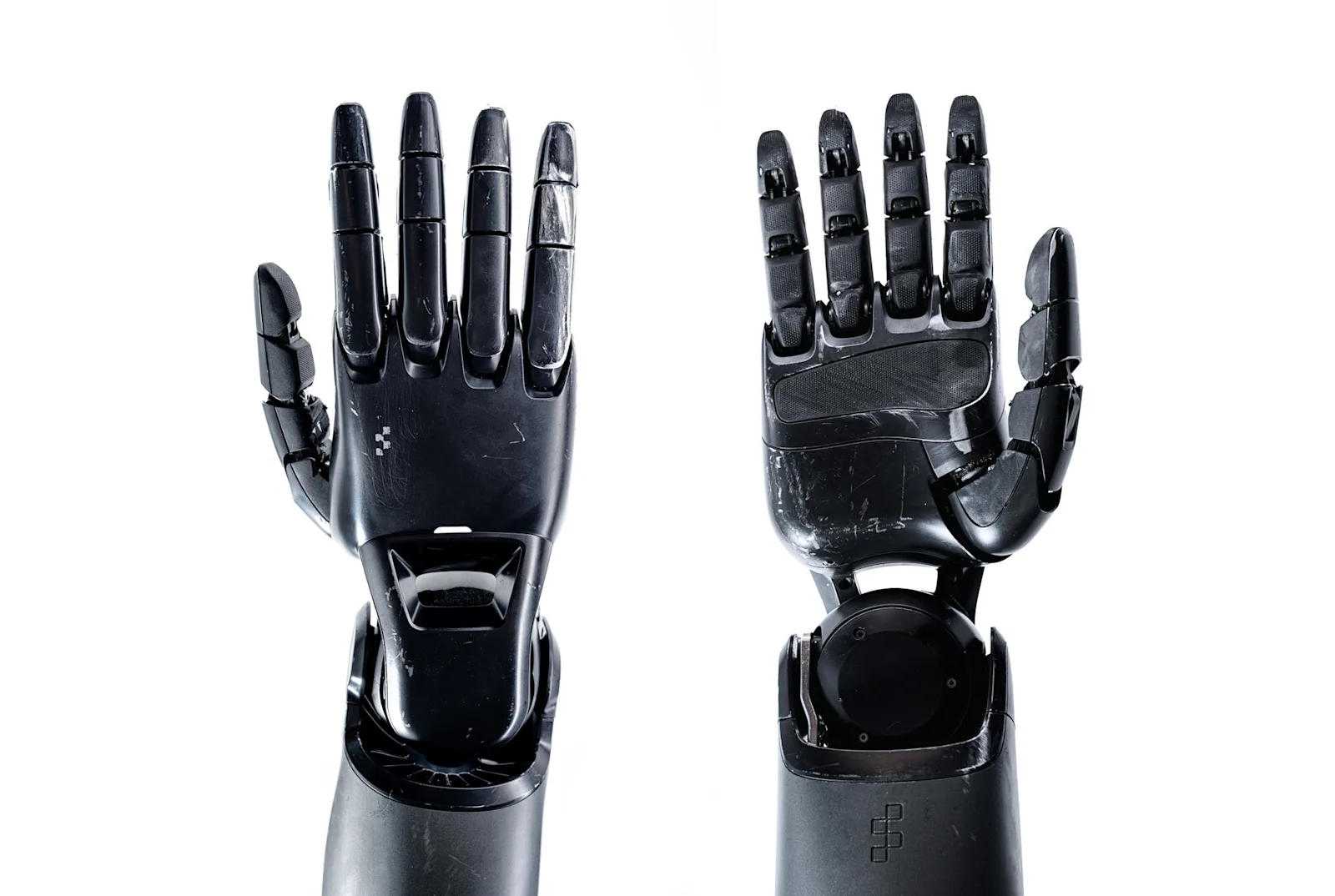
1) The CES 2026 “why now” in four proof points
CES runs Jan 6–9 in Las Vegas, and the official programming leaned hard into physical AI and robotics as a top-line theme (not a side show).1 What stood out this year is that multiple parts of the ecosystem crossed from “cool demo” into “repeatable deployment.”
AGIBOT says it rolled out its 5,000th mass-produced humanoid robot, a sharp signal that humanoids are entering an industrial-scale phase.
Source: AGIBOT announcement2
Figure reports its Figure 02 fleet ran an 11-month deployment at BMW, loading 90,000+ parts and contributing to 30,000+ vehicles.
Mobileye agreed to acquire humanoid startup Mentee Robotics for about $900M, applying AV-grade perception stacks to embodied AI.
Source: Reuters5
Hyundai (Boston Dynamics) outlined a plan to scale Atlas for manufacturing use, including a goal of a production system capable of 30,000 robots annually by 2028.
Source: Reuters6
Chart: Humanoid manufacturing scale is now measurable
Two data points don't make a market, but they do make a trend: companies are talking in thousands (and soon tens of thousands) of robots.
2) The robots: less sci-fi, more supply chain
Instead of trying to summarize “all robots at CES,” here are three snapshots that show the range: mass-produced humanoids, factory-validated humanoids, and enterprise-scale roadmaps.

AGIBOT A2
Mass-produced humanoid product line for service and guidance applications.
- A product page that reads like consumer electronics: standardized specs, repeatable manufacturing.
- Milestones are now in units shipped (5,000th mass-produced robot), not just demo videos.
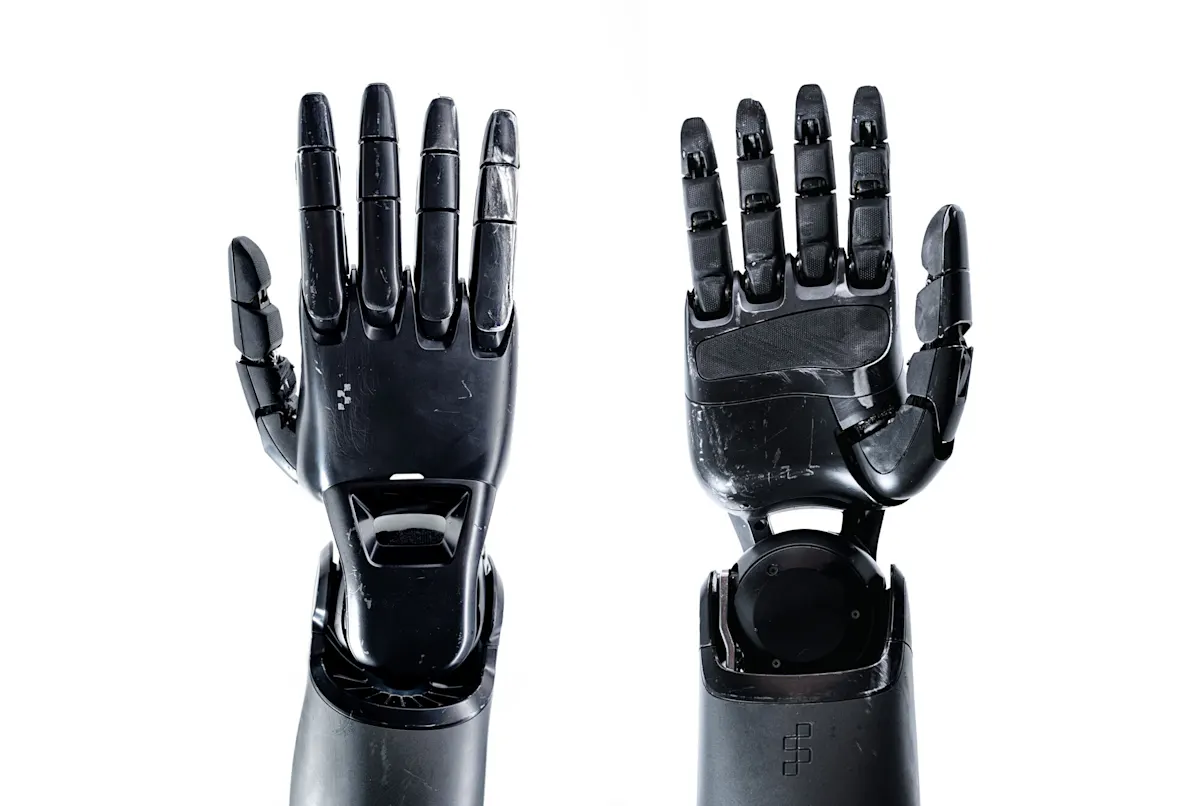
Figure 02 @ BMW
An 11-month factory deployment with published KPIs.
- A rare thing in humanoids: an operational report with explicit KPIs (cycle time, accuracy, interventions).
- Factory reality forces 'boring' improvements: reliability, wiring, thermals, and calibration tools.
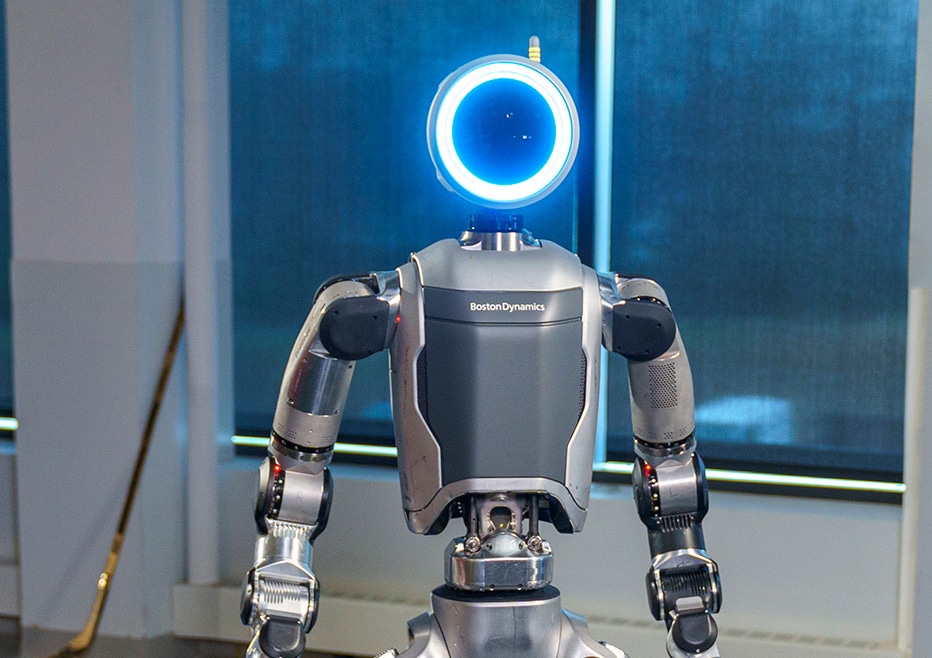
Boston Dynamics Atlas (Hyundai roadmap)
Industrial humanoids as an automotive-scale program.
- When automakers talk about robots like a platform program, the supply chain follows.
- The interesting part is not the humanoid shape. It's the factory, network, and operations model around it.

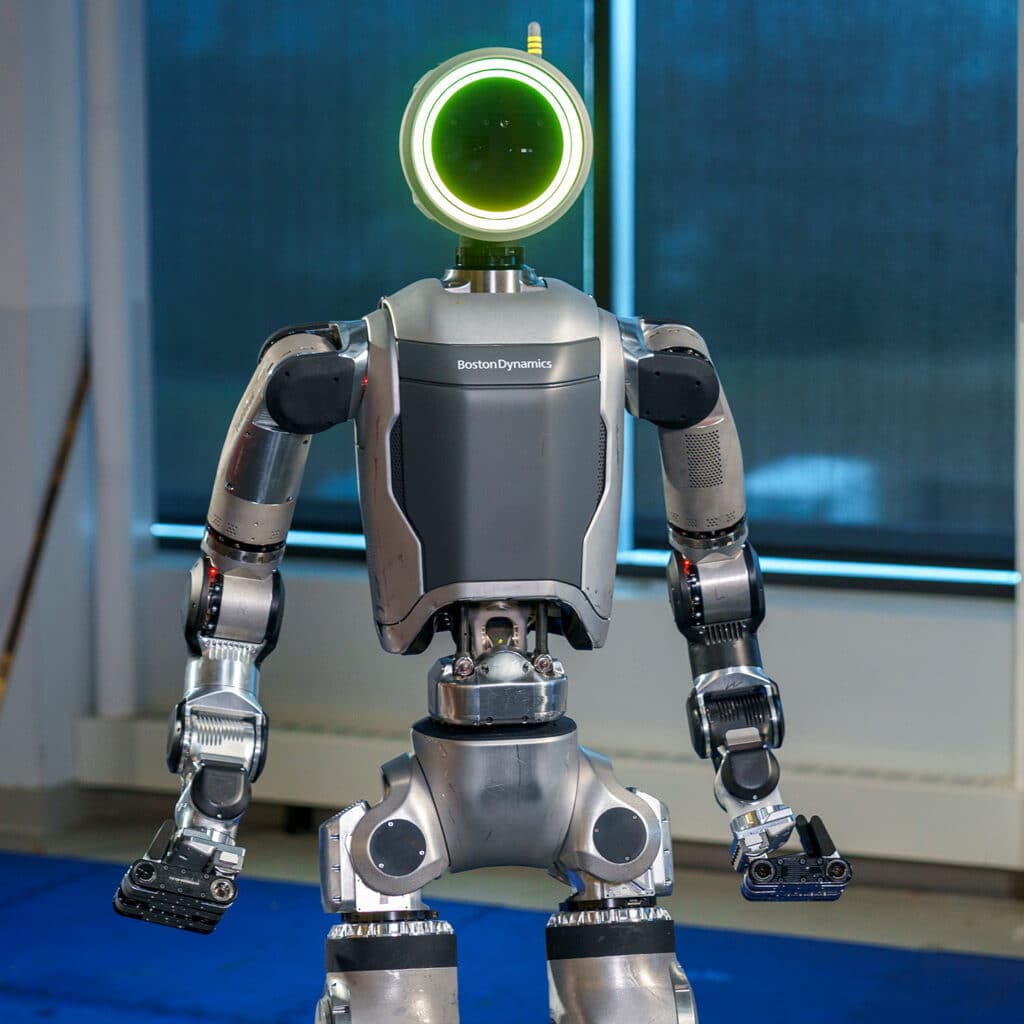
Figure 02 on the BMW factory floor
Watch Figure's humanoid robots in action at the BMW Spartanburg plant. 11 months of deployment, 1,250+ runtime hours, 90,000+ parts loaded.
Watch full videoChart: Factory KPIs look like this (cycle time)
In its BMW deployment write-up, Figure defined a cycle-time requirement of 84 seconds total, with 37 seconds for the loading phase.4 That's a real factory constraint, not a stage demo.
3) The “latency cliff”: why the cloud isn’t the robot brain
A chatbot can stall for a second and you’ll still call it “smart.” A robot that stalls for a second looks broken, or even dangerous.
The key trick is to split intelligence into layers: reflex (sub-millisecond to ~1ms), sensorimotor control (tens of ms), and higher-level reasoning (hundreds of ms). That’s why the edge matters: it’s the only place close enough to fit inside these budgets.
Chart: Latency budgets by “brain layer”
Ranges are illustrative engineering targets used across robotics control stacks. (Use this chart as a mental model, not a spec sheet.)
Reflex + safety + real-time perception
- Runs fast loops: balance, collision avoidance, actuator control.
- Where you keep the system safe when the network drops.
- Where bigger local models start to matter (less dependency on round trips).
Low-latency coordination + heavier perception
- Good place for shared world models, fleet coordination, and compute that's too heavy for every robot.
- Private connectivity + direct interconnect matter more than raw bandwidth.
- Often the 'Goldilocks zone' between device and cloud.
Training, long-horizon analytics, large-scale reasoning
- Where your fleet data becomes new models.
- Where you do large retrains, evaluation, and simulation at scale.
- Where the cost curve matters: cheaper tokens → more reasoning everywhere.
4) The uplink crisis: robots talk up, not down
Consumer internet was built for downloads. Robots do the opposite: cameras, depth sensors, force sensors, logs, and “what I saw” datasets all flow upstream. Multiply one robot by a fleet, and the numbers get silly fast.
That’s why the boring parts of CES matter: private cellular, 5G-Advanced (3GPP Release 18 and beyond), and edge interconnect. In Release 17/18-era materials, vendors highlight positioning latency as low as ~10ms and other uplink/coverage enhancements geared toward industrial uses.13
Chart: Illustrative uplink demand (single robot → fleet)
Example ranges (Mbps). Update these numbers to match your specific sensor stack and compression pipeline.
Table: Network requirements by robotic task (cheat sheet)
A quick planner for where compute should run (device vs edge vs cloud). Treat as a starting point.
| Task | Latency target | Typical uplink | Where compute lives | Why |
|---|---|---|---|---|
| Balance / collision reflex | <1–5ms | Minimal | On-device | Safety can’t wait for the network. |
| Hand-eye manipulation | 10–30ms | Low–medium | Device + Edge | Sometimes you offload perception, keep control local. |
| Tele-operation assist | 30–100ms | High (video up) | Edge | Human-in-the-loop needs stability + bandwidth. |
| Fleet learning / logging | Seconds–hours | Very high (burst) | Cloud | Training, analytics, and long-horizon optimization. |
Note: This table is synthesized from the provided deep research report and common robotics architecture patterns.
5) Silicon: training beasts in the cloud, “robot brains” on the body
CES 2026 was unusually coherent across the stack: the biggest chip vendor launched a next-gen data center platform, while edge modules and robotics processors sharpened their pitch around running bigger models locally.
NVIDIA introduced Rubin as a six-chip platform with “extreme codesign,” aiming to cut inference token cost vs Blackwell and scale AI factories.7
- Theme: rack-scale systems + networking + storage as one product
- Why it matters: cheaper reasoning makes more AI workloads viable
Jetson Thor is positioned as a compact, power-efficient “real-time reasoning” computer for demanding edge applications like humanoid robots.9
- Spec headline: up to 2070 FP4 TFLOPS, 128GB memory, 40–130W10
- Why it matters: bigger models can run locally (less round-trip)
Qualcomm’s Dragonwing push frames robotics as the next destination for its energy-efficient compute heritage, with partners spanning humanoids to industrial robotics.11
- Positioning: “power efficiency + safety + scalability”11
- Watch for: developer ecosystems + reference designs
So what?
The robot is becoming a new "endpoint" category, similar to smartphones in the 2010s. The winners won’t just ship robots; they’ll ship the inference topology that keeps those robots safe, responsive, and continuously improving.
Sources & credits
This post is built from the provided deep research report plus public CES-week announcements and reporting. Links below are numbered to match inline footnotes.
-
#1 CES 2026 official site (dates + robotics/physical AI trend videos)Open ↗
-
#2 AGIBOT press release/announcement: 5,000th mass-produced humanoid robotOpen ↗
-
#3 AGIBOT A2 product page (specs: 169cm, 69kg, 700Wh, 40+ DoF)Open ↗
-
#4 Figure AI: F.02 contributed to production of 30,000+ cars at BMW (deployment metrics)Open ↗
-
#5 Reuters: Mobileye to acquire Mentee Robotics for about $900M (Jan 6, 2026)Open ↗
-
#6 Reuters: Hyundai plans to deploy Atlas humanoid robots; 30,000 robots/year capacity by 2028 (Jan 5, 2026)Open ↗
-
#7 NVIDIA Newsroom: Rubin platform launch (six-chip platform; in production; availability 2H 2026)Open ↗
-
#8 NVIDIA Blog: CES 2026 special presentation (Rubin + open models)Open ↗
-
#9 CES Innovation Awards: NVIDIA Jetson ThorOpen ↗
-
#10 NVIDIA Jetson Thor product page (up to 2070 FP4 TFLOPS; 128GB; 40–130W)Open ↗
-
#11 Automate.org: Qualcomm Dragonwing robotics developer platform at CES 2026Open ↗
-
#12 Nokia: 5G-Advanced explained (Release 18 era)Open ↗
-
#13 Qualcomm PDF: A closer look at 5G-Advanced Release 18 (positioning, uplink, mobility enhancements)Open ↗
-
#14 Equinix blog: metro edge + AI inference (<10ms proximity)Open ↗
-
#15 Boston Dynamics: Electric Atlas humanoid robot (2024 announcement + product page)Open ↗