1M
NVDA$207.14+3.2%
MSFT$486.19+4.6%
GOOGL$375.19+5.4%
AAPL$303.05-1.9%
AMZN$285.86+5.3%
META$593.44+6.6%
TSLA$323.64+4.0%
IBM$226.69+1.4%
CRM$188.81+2.6%
AMD$480.57+0.9%
AVGO$388.72-0.1%
ARM$236.96-1.1%
TSM$403.29-0.2%
INTC$90.31+0.1%
QCOM$149.23+1.1%
MU$815.37-0.9%
CSCO$115.21-0.7%
ANET$181.33+0.5%
SMCI$28.45+0.2%
ORCL$137.58+5.9%
PLTR$125.14+1.7%
DELL$417.14+2.9%
HPE$49.03+2.4%
PSTG$77.17+2.8%
ALAB$317.11+1.9%
AMAT$511.65+0.8%
LRCX$290.96-0.7%
KLAC$179.81-1.6%
ASML$1,635.04+0.4%
TER$362.31-1.5%
GEV$997.86+0.8%
CEG$272.41+3.7%
UEC$9.82+2.3%
OKLO$41.30+6.4%
SMR$8.92+5.9%
BWXT$172.80+2.4%
VST$153.96+3.9%
D$68.80-0.5%
SO$94.22-0.3%
NEE$86.33-0.7%
CCJ$89.54+3.7%
LEU$183.35+3.6%
BE$217.12+5.5%
KMI$31.66-1.6%
EXC$45.68-0.3%
VRT$258.15+6.9%
ETN$432.93+4.3%
CAT$823.61+1.1%
PWR$674.29+1.0%
EME$814.20+2.1%
URI$1,103.76+2.3%
VMC$278.76+3.8%
J$138.17+2.4%
TT$461.02+1.3%
CARR$62.65+1.4%
JCI$146.68+0.0%
SIEGY$162.90-0.1%
ALB$119.04+1.2%
SQM$66.71-0.5%
LAC$2.97+3.5%
MP$43.73+5.7%
FCX$63.24+1.0%
GLW$145.80+5.5%
SCCO$185.35+1.4%
AA$44.55-1.6%
RIO$95.41-1.5%
VALE$14.57-3.3%
LYSDY$9.80-1.4%
EQIX$1,024.62+0.5%
DLR$191.93+1.8%
AMT$174.17+0.5%
LITE$761.92+6.7%
COHR$287.52+9.4%
CIEN$383.36+1.7%
IRM$124.97+2.2%
CCI$78.36+2.7%
MDB$357.81+6.0%
ADBE$253.37+1.2%
RIVN$15.58+2.4%
DDOG$275.55+2.8%
SNOW$312.84+6.7%
NOW$114.95+3.3%
PATH$13.02+2.0%
CRWD$197.10+3.3%
NVDA$207.14+3.2%
MSFT$486.19+4.6%
GOOGL$375.19+5.4%
AAPL$303.05-1.9%
AMZN$285.86+5.3%
META$593.44+6.6%
TSLA$323.64+4.0%
IBM$226.69+1.4%
CRM$188.81+2.6%
AMD$480.57+0.9%
AVGO$388.72-0.1%
ARM$236.96-1.1%
TSM$403.29-0.2%
INTC$90.31+0.1%
QCOM$149.23+1.1%
MU$815.37-0.9%
CSCO$115.21-0.7%
ANET$181.33+0.5%
SMCI$28.45+0.2%
ORCL$137.58+5.9%
PLTR$125.14+1.7%
DELL$417.14+2.9%
HPE$49.03+2.4%
PSTG$77.17+2.8%
ALAB$317.11+1.9%
AMAT$511.65+0.8%
LRCX$290.96-0.7%
KLAC$179.81-1.6%
ASML$1,635.04+0.4%
TER$362.31-1.5%
GEV$997.86+0.8%
CEG$272.41+3.7%
UEC$9.82+2.3%
OKLO$41.30+6.4%
SMR$8.92+5.9%
BWXT$172.80+2.4%
VST$153.96+3.9%
D$68.80-0.5%
SO$94.22-0.3%
NEE$86.33-0.7%
CCJ$89.54+3.7%
LEU$183.35+3.6%
BE$217.12+5.5%
KMI$31.66-1.6%
EXC$45.68-0.3%
VRT$258.15+6.9%
ETN$432.93+4.3%
CAT$823.61+1.1%
PWR$674.29+1.0%
EME$814.20+2.1%
URI$1,103.76+2.3%
VMC$278.76+3.8%
J$138.17+2.4%
TT$461.02+1.3%
CARR$62.65+1.4%
JCI$146.68+0.0%
SIEGY$162.90-0.1%
ALB$119.04+1.2%
SQM$66.71-0.5%
LAC$2.97+3.5%
MP$43.73+5.7%
FCX$63.24+1.0%
GLW$145.80+5.5%
SCCO$185.35+1.4%
AA$44.55-1.6%
RIO$95.41-1.5%
VALE$14.57-3.3%
LYSDY$9.80-1.4%
EQIX$1,024.62+0.5%
DLR$191.93+1.8%
AMT$174.17+0.5%
LITE$761.92+6.7%
COHR$287.52+9.4%
CIEN$383.36+1.7%
IRM$124.97+2.2%
CCI$78.36+2.7%
MDB$357.81+6.0%
ADBE$253.37+1.2%
RIVN$15.58+2.4%
DDOG$275.55+2.8%
SNOW$312.84+6.7%
NOW$114.95+3.3%
PATH$13.02+2.0%
CRWD$197.10+3.3%
NVDA$207.14+3.2%
MSFT$486.19+4.6%
GOOGL$375.19+5.4%
AAPL$303.05-1.9%
AMZN$285.86+5.3%
META$593.44+6.6%
TSLA$323.64+4.0%
IBM$226.69+1.4%
CRM$188.81+2.6%
AMD$480.57+0.9%
AVGO$388.72-0.1%
ARM$236.96-1.1%
TSM$403.29-0.2%
INTC$90.31+0.1%
QCOM$149.23+1.1%
MU$815.37-0.9%
CSCO$115.21-0.7%
ANET$181.33+0.5%
SMCI$28.45+0.2%
ORCL$137.58+5.9%
PLTR$125.14+1.7%
DELL$417.14+2.9%
HPE$49.03+2.4%
PSTG$77.17+2.8%
ALAB$317.11+1.9%
AMAT$511.65+0.8%
LRCX$290.96-0.7%
KLAC$179.81-1.6%
ASML$1,635.04+0.4%
TER$362.31-1.5%
GEV$997.86+0.8%
CEG$272.41+3.7%
UEC$9.82+2.3%
OKLO$41.30+6.4%
SMR$8.92+5.9%
BWXT$172.80+2.4%
VST$153.96+3.9%
D$68.80-0.5%
SO$94.22-0.3%
NEE$86.33-0.7%
CCJ$89.54+3.7%
LEU$183.35+3.6%
BE$217.12+5.5%
KMI$31.66-1.6%
EXC$45.68-0.3%
VRT$258.15+6.9%
ETN$432.93+4.3%
CAT$823.61+1.1%
PWR$674.29+1.0%
EME$814.20+2.1%
URI$1,103.76+2.3%
VMC$278.76+3.8%
J$138.17+2.4%
TT$461.02+1.3%
CARR$62.65+1.4%
JCI$146.68+0.0%
SIEGY$162.90-0.1%
ALB$119.04+1.2%
SQM$66.71-0.5%
LAC$2.97+3.5%
MP$43.73+5.7%
FCX$63.24+1.0%
GLW$145.80+5.5%
SCCO$185.35+1.4%
AA$44.55-1.6%
RIO$95.41-1.5%
VALE$14.57-3.3%
LYSDY$9.80-1.4%
EQIX$1,024.62+0.5%
DLR$191.93+1.8%
AMT$174.17+0.5%
LITE$761.92+6.7%
COHR$287.52+9.4%
CIEN$383.36+1.7%
IRM$124.97+2.2%
CCI$78.36+2.7%
MDB$357.81+6.0%
ADBE$253.37+1.2%
RIVN$15.58+2.4%
DDOG$275.55+2.8%
SNOW$312.84+6.7%
NOW$114.95+3.3%
PATH$13.02+2.0%
CRWD$197.10+3.3%
AI Infrastructure Semiconductors CES 2026

The Real AI Chip War: Memory Bandwidth Becomes the Critical Bottleneck in 2026

NVIDIA's Rubin and AMD's Helios platforms reveal the new battleground. It's all about how fast you can feed the processor.

January 14, 2026 | 12 min read
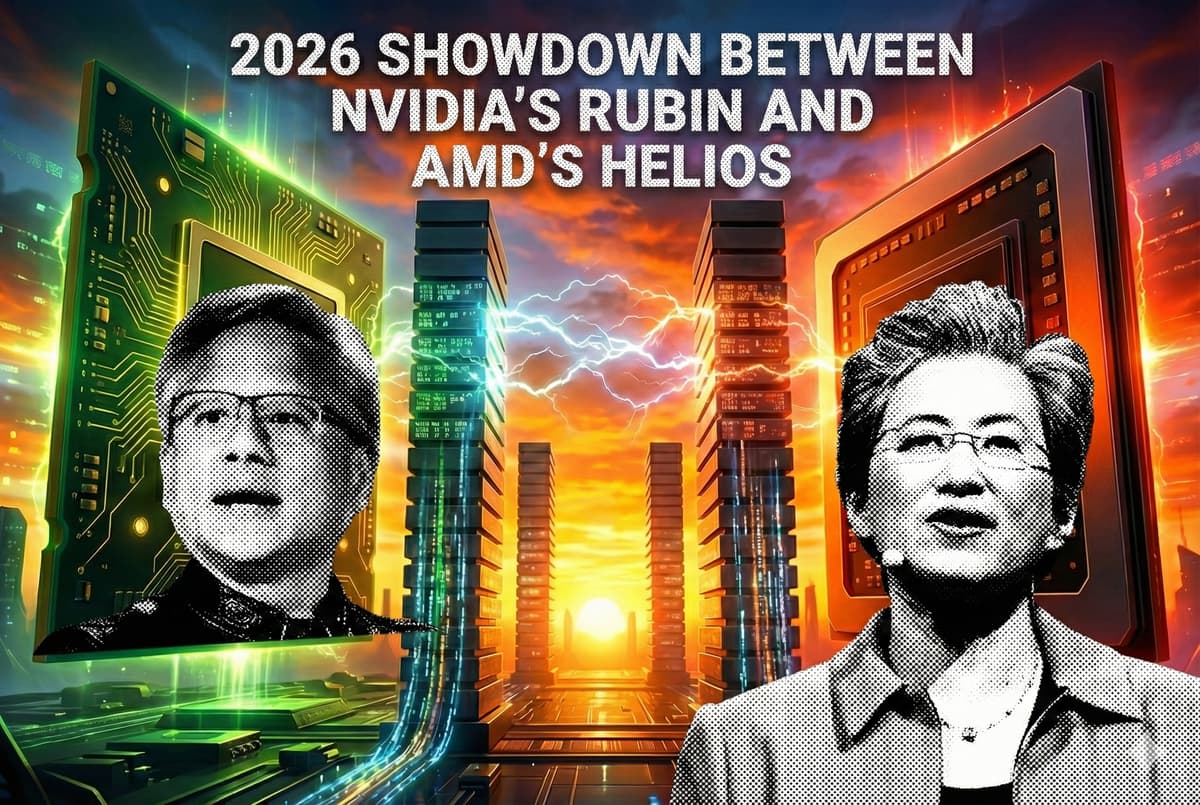
2026 Showdown Between NVIDIA's Rubin and AMD's Helios - Jensen Huang and Lisa Su

Imagine buying a sports car that can go 200 miles per hour, only to discover the fuel pump can only deliver gas at 40 mph. That's the situation facing AI data centers today. The most powerful processors in the world spend most of their time waiting for data to arrive.

At CES 2026, both NVIDIA and AMD unveiled new chip platforms built around a single insight: raw computing power no longer determines AI performance. The real bottleneck is memory bandwidth, the speed at which data flows to the processor. Both companies announced architectures centered on HBM4, a new memory technology that doubles data throughput compared to the previous generation.

This shift has massive implications. The hyperscalers are spending $600 billion on AI infrastructure in 2026. NVIDIA holds 88-92% of the data center AI chip market. But AMD's aggressive memory capacity advantage, 50% more HBM4 per GPU, could reshape buying decisions for enterprises running trillion-parameter models.

Why Your GPU Waits for Data

Modern large language models expose a counterintuitive truth: adding more computational horsepower doesn't make them faster. During inference, when an AI generates each word of a response, the processor spends most of its time waiting for model weights to arrive from memory.

Think of it like a factory assembly line. The workers (the GPU compute cores) can build things incredibly fast, but they're constantly waiting for parts (data) to be delivered from the warehouse (memory). No matter how many workers you add, the line can only move as fast as parts arrive.

The math is straightforward. A 70-billion parameter model in standard precision requires 140 GB just for weights, plus additional memory for the key-value cache that grows with every generated token. Token generation speed follows a simple formula: time per token equals bytes moved divided by memory bandwidth.

The Memory Wall in Action

On NVIDIA's older A10 GPU with 600 GB/s bandwidth, a 7B model produces about 23 milliseconds per token. On an A100 with 2,039 GB/s bandwidth, that drops to 6 milliseconds. The A100 isn't faster at math. It just reads data faster.

This "memory wall" explains why both NVIDIA and AMD have made HBM4 the centerpiece of their 2026 architectures. HBM4 doubles the interface width from 1,024 bits to 2,048 bits per stack. Think of it as adding more lanes to a highway rather than raising the speed limit.

Memory Bandwidth Has Doubled Every Generation

Source: JEDEC specifications, manufacturer announcements. Bandwidth shown per stack.

NVIDIA Rubin: The New Powerhouse NVIDIA

NVIDIA officially launched the Rubin platform at CES 2026, with CEO Jensen Huang describing it as "in full production" and available to partners in the second half of 2026. Named after astrophysicist Vera Rubin (who discovered evidence for dark matter), the platform pairs Rubin GPUs with new Vera CPUs in what NVIDIA calls the "Vera Rubin Superchip."

The headline numbers are striking: Rubin delivers 5x the inference performance of Blackwell while reducing token costs to one-tenth the previous level. Jensen Huang claims customers will need only one-quarter as many GPUs to train mixture-of-experts models, potentially transforming data center economics.

NVIDIA CES 2026 Keynote: Jensen Huang introduces the Rubin platform

Rubin GPU Specifications

Specification Rubin GPU vs. Blackwell
Transistors 336 billion 1.6x increase
Process node TSMC 3nm One generation newer
Memory type HBM4 New generation
Memory per GPU 288 GB 1.5x more
Memory bandwidth 22 TB/s 2.8x faster
FP4 inference 50 petaFLOPS 5x higher
NVLink bandwidth 3.6 TB/s 2x faster

Rubin's architecture uses two near-reticle-sized compute dies plus two I/O dies, packaged using TSMC's advanced CoWoS-L technology. The system connects to 8 stacks of HBM4 running at 6.4 GT/s per pin.

For long-context AI applications, the Vera CPU's 1.5 TB of LPDDR5X memory can serve as extended KV cache storage, accessible at 1.8 TB/s through NVLink-C2C. NVIDIA also previewed Rubin Ultra for 2027, featuring 4 compute dies per package, 1 TB of HBM4E memory, and 100 petaFLOPS of FP4 performance.

AMD Helios: The Memory Capacity Play AMD

AMD revealed its counter-strategy at CES 2026: rather than chase NVIDIA's compute lead, focus on memory capacity advantage. The Helios platform, built on AMD's CDNA 5 architecture, delivers 432 GB of HBM4 per MI455X accelerator, 50% more than Rubin's 288 GB.

AMD CEO Lisa Su called Helios "the world's best AI rack" at CES 2026. The pitch centers on three differentiators: more memory for larger models, lower power consumption per accelerator, and open standards (ROCm software, UALink interconnect) versus NVIDIA's proprietary CUDA ecosystem.

AMD CES 2026 Keynote: Lisa Su introduces the Helios platform and MI455X

NVIDIA Rubin vs AMD Helios: Head-to-Head

Source: Company announcements at CES 2026. Higher is better for all metrics except price.

Helios represents AMD's first rack-scale AI platform, designed to Meta's Open Rack Wide (ORW) specification. Each rack contains 72 MI455X accelerators paired with 18 EPYC "Venice" CPUs (Zen 6, up to 256 cores each). The result: 2.9 exaFLOPS of FP4 performance with 31 TB of total HBM4 memory.

Major wins suggest momentum: OpenAI committed to 6 GW of MI450-series deployments beginning in the second half of 2026, Oracle signed for 50,000 GPUs, and the U.S. Department of Energy awarded AMD a $1 billion supercomputer contract.

"MI440X appears positioned as a time-to-value option for enterprises dealing with regulated data, data residency mandates, and latency-sensitive inference. But NVIDIA's dominance only becomes meaningfully threatened if ROCm evolves into a true equivalent of CUDA." — Rachita Rao, Everest Group analyst

HBM4: The Technology Enabling It All

Both platforms depend on HBM4, the newest high-bandwidth memory standard that reached mass production in early 2026. The technology represents more than incremental improvement. It's an architectural redesign.

The key innovation is HBM4's logic base die, which moves memory controller functions from the GPU to the memory stack itself. This enables "customized HBM" where customers can specify different logic features, while the standardized interface ensures compatibility. Think of it as memory becoming a co-processor, not just a passive storage bin.

The 2,048-bit interface doubles data paths without requiring aggressive clock speeds, improving power efficiency. Hybrid bonding technology eliminates the micro-bumps previously required between stacked memory layers, reducing thermal resistance and enabling taller stacks. Samsung has demonstrated 16-layer HBM4 using this approach.

HBM Evolution: Bandwidth and Capacity Per Stack

Source: JEDEC specifications, manufacturer data sheets. HBM4 values are for 36GB stacks.

HBM Generation Comparison

Feature HBM3 HBM3E HBM4
Interface width 1,024-bit 1,024-bit 2,048-bit
Bandwidth per stack ~819 GB/s ~1.2 TB/s 1.6-2.56 TB/s
Capacity per stack 16-24 GB 24-36 GB 36-64 GB
Stack height 8-12 layers 8-12 layers 12-16 layers
Base die process Memory node Memory node Logic (12nm/5nm)

Three Companies Control the World's HBM Supply

The memory war has a supply problem: all three HBM manufacturers are sold out through 2026, with demand exceeding production capacity by at least 10%.

HBM Market Share by Manufacturer

Source: Industry estimates, UBS research. Market share figures are approximate and vary by source.

SK Hynix dominates with roughly 70% of NVIDIA's Rubin HBM4 orders according to UBS estimates. The company began mass production of 36 GB HBM4 stacks in February 2026, four months ahead of schedule, and has signed a letter of intent with OpenAI's Stargate project for 900,000 DRAM wafers monthly.

Samsung, after stumbling on HBM3E certification in early 2025, has recovered significantly. Its CEO reported that "customers have even stated 'Samsung is back'" following successful HBM4 quality validation with NVIDIA. The company plans to nearly double capacity to 250,000 wafers monthly by end of 2026.

Micron is playing catch-up but moving aggressively, breaking ground in January 2026 on what it calls "the largest US semiconductor facility" in New York. The company shipped HBM4 samples at 11 Gbps and targets 30% market share by year-end.

Pricing Reflects Scarcity

HBM4 modules command $500+ each versus $250-350 for HBM3E, a 100% premium. Overall memory prices are expected to rise 50-55% in Q1 2026 versus Q4 2025, with ripple effects hitting consumer devices from PCs to smartphones.

The $600 Billion Bet

The big cloud providers aren't waiting to pick winners. They're buying everything available while developing their own alternatives.

2026 Estimated AI Infrastructure CapEx

Source: Company guidance, analyst estimates. Figures represent total CapEx, with significant portions allocated to AI.

Hyperscaler AI Strategies

Company 2026 CapEx (Est.) AI Strategy
Amazon/AWS >$125B Trainium 3 custom chips; 45% price cut on NVIDIA instances
Microsoft ~$94B Azure Maia 100 custom accelerators; Fairwater liquid-cooled datacenters
Google Accelerating TPU v7 "Ironwood" matches Blackwell FP8 performance
Meta "Notably larger" 1 million GPU cluster build-out
Oracle Growing Stargate I campus: 1.2 GW capacity, 450,000+ GB200 GPUs

The combined spending represents roughly 36% year-over-year growth in AI infrastructure investment. Yet returns remain uncertain: AI services are expected to deliver only about $25 billion in revenue in 2025, roughly 10% of infrastructure spending. Only 25% of AI initiatives have delivered expected ROI to date.

HBM Market Trajectory

The consensus estimate projects the HBM market reaching $54.6 billion in 2026 (58% year-over-year growth) and $100 billion by 2028. This growth is driven by AI demand outpacing all other semiconductor categories.

HBM Market Size Growth

Source: Industry analyst estimates, company guidance. 2026-2028 figures are projections.

Investment Outlook

Wall Street is broadly bullish on the memory war's participants, though with different risk profiles.

NVIDIA

$270-340

Analyst price targets (current ~$190)

40%+ upside based on Rubin's performance. Key risk: HBM supply constraints.

AMD

$270-300

Analyst price targets (current ~$220)

KeyBanc upgraded to Overweight Jan 13. Key risk: ROCm software trails CUDA.

Memory suppliers offer potentially underappreciated upside:

  • SK Hynix: Bank of America's "Top Pick" for the memory supercycle
  • Micron: Trading at just 9.9x forward earnings despite 242% gains over 12 months
  • Samsung: Q4 2025 operating profit exceeded $14 billion, 30% above forecasts

What to Watch in Q3/Q4 2026

  • Rubin general availability ramp and any HBM supply constraints
  • AMD Helios production ramp coinciding with OpenAI's 1 GW deployment
  • HBM4 supply dynamics as all three suppliers reach steady-state production
  • Regulatory scrutiny of NVIDIA's CUDA bundling practices

The Memory Bottleneck Reshapes AI's Future

The Rubin versus Helios competition illustrates a fundamental architectural truth: AI's progress is now gated by memory, not math. NVIDIA's approach optimizes bandwidth per watt; AMD's approach maximizes capacity per dollar. Both acknowledge that raw FLOPS, the metric that defined GPU competition for decades, matters less than how fast processors can access data.

For data center operators, this means evaluating workloads carefully. Training frontier models with NVIDIA's ecosystem advantages? Rubin likely wins. Running large inference workloads on-premises with cost sensitivity? Helios deserves serious consideration. Hyperscale cloud providers? Build custom ASICs while buying both.

For investors, the bottleneck shift redirects attention to memory suppliers and packaging capacity, the less glamorous but equally constrained links in AI's supply chain.

The war for memory has just begun, but its outcome will determine who can actually run the AI models of 2027 and beyond. In a world where processors routinely deliver petaFLOPS of theoretical performance, victory goes to whoever can feed them data fast enough to matter.

Full Architecture Comparison

Feature NVIDIA Rubin AMD Helios (MI455X)
Architecture Rubin (Vera Rubin Superchip) CDNA 5
Process TSMC 3nm TSMC 2nm/3nm
Transistors 336 billion 320 billion
Memory/GPU 288 GB 432 GB
Memory BW/GPU 22 TB/s 19.6 TB/s
FP4 Performance 50 PFLOPS 40 PFLOPS
Rack Memory 20.7 TB 31 TB
TDP/GPU ~1,800W ~1,000-1,400W
Software CUDA (proprietary) ROCm (open)
Est. Rack Price ~$4.7M ~$2.9M
Availability H2 2026 H2 2026

Sources: NVIDIA CES 2026 keynote, AMD CES 2026 keynote, company press releases, analyst reports from UBS, KeyBanc, Bank of America, Everest Group. Data accurate as of January 14, 2026.